
The Autolinee Toscane products reviewed on September 29, 2026 do not show a single roaming tourist pass specifically designed for unrestricted travel between Florence, Siena and San Gimignano. The operator instead structures suburban season passes around a selected origin and destination, while the three places are served through connected route corridors.
Direct answer: For a trip involving Florence, Siena and San Gimignano, it is safer to think in terms of the actual bus segments rather than one all-area pass. Florence and Siena are linked through the 131/131R corridor, while line 130 covers the Siena-Poggibonsi-San Gimignano corridor. The appropriate fare therefore depends on the journeys that will actually be made.
Is there one bus pass for Florence, Siena and San Gimignano?
Within the Autolinee Toscane fare material checked for this article, there is no clearly identified network-style pass marketed specifically for free travel among all three destinations. That conclusion is deliberately limited to the operator products reviewed: it should not be read as proof that no third-party tourist product of any kind could exist.
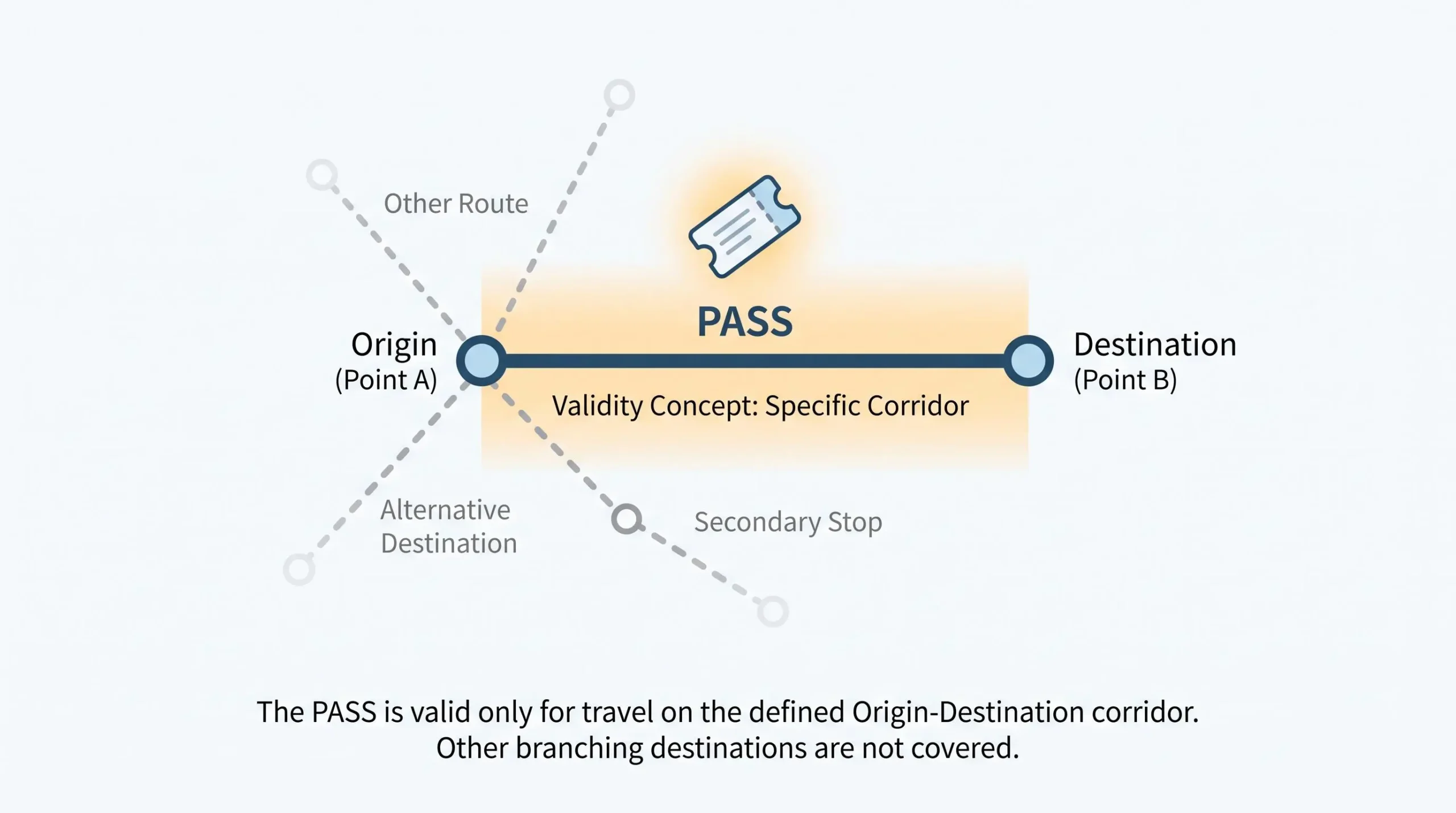
The key distinction: an ordinary suburban season pass is linked to a defined origin-destination journey. It should not be interpreted automatically as an unlimited Tuscany-wide travel product.
This matters because the word “pass” can suggest much broader validity than the fare product actually provides. For a traveler moving only occasionally between major sightseeing stops, the useful question is not simply “Is there a pass?” but “Which journeys will be made, and does a route-specific subscription correspond to those journeys?”
How Autolinee Toscane suburban passes actually work
According to Autolinee Toscane, the suburban monthly pass is purchased for a chosen origin and destination and is valid for the origin-destination route indicated on the pass as well as the return journey. This is the central rule to understand before comparing a season pass with individual tickets.
The published ordinary monthly pass currently starts at €43.40, with the applicable amount depending on the relevant distance band. That figure is a minimum published fare, not a verified price for a Florence-Siena-San Gimignano itinerary, so it should not be used as the cost of the complete trip.
| Criterion | Individual tickets | Route-specific season pass |
|---|---|---|
| Best question to ask | Which individual journeys will be made? | Will the same origin-destination corridor be used repeatedly? |
| Validity logic | Applies to the purchased journey | Defined around the origin-destination route stated on the pass |
| Good for comparison | Occasional sightseeing travel | Repeated use of the same corridor |
| What not to assume | That several separate tickets are automatically more expensive | That the pass covers unrelated destinations throughout Tuscany |
The practical implication is simple: calculate the itinerary first, then compare the relevant fare products. There is no verified universal number of journeys at which a season pass becomes the better choice, so an artificial break-even threshold would be misleading.
How the three destinations connect by bus
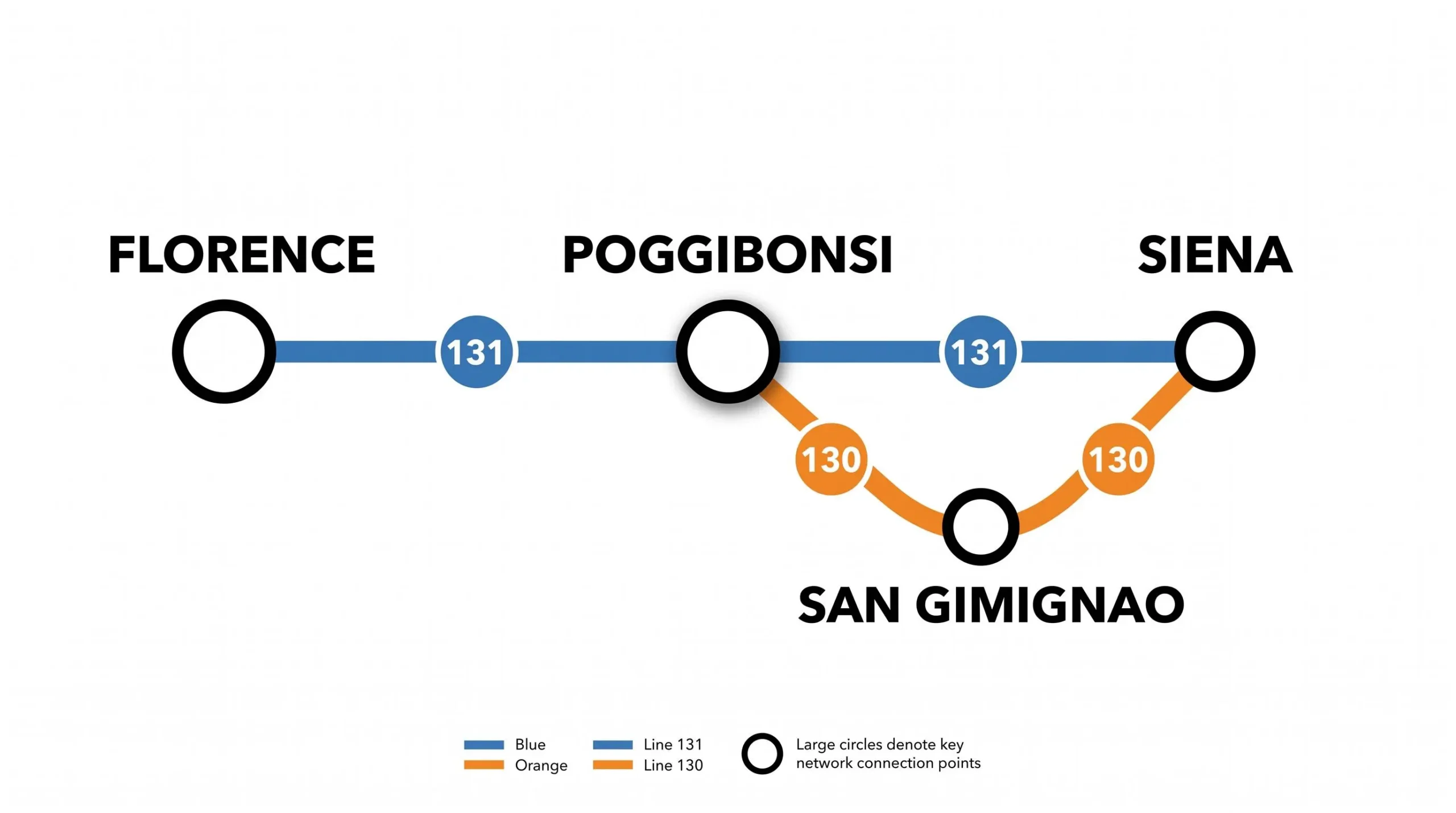
The route network becomes clearer when it is divided into two corridors. Autolinee Toscane identifies line 131 route as the Siena-Colle di Val d’Elsa-Poggibonsi-Florence service. This establishes the main Florence-Siena corridor and also places Poggibonsi within it.
Poggibonsi is useful to understand because it also appears on the service toward San Gimignano. That makes it an important network connection point, but it does not mean that every itinerary requires a transfer there or that a specific connection is guaranteed. The actual departure pattern should be checked for the intended travel date.
For the second corridor, the operator’s line 130 route covers Siena, Poggibonsi and San Gimignano. Together, lines 131 and 130 explain how the three destinations fit into the regional bus network without assuming that they form one single through service.
| Criterion | Line 131 | Line 130 |
|---|---|---|
| Verified corridor | Siena-Colle di Val d’Elsa-Poggibonsi-Florence | Siena-Poggibonsi-San Gimignano |
| Key role | Connects the Florence-Siena side of the itinerary | Connects San Gimignano with Siena and Poggibonsi |
| Shared network point | Poggibonsi | Poggibonsi |
| Still needs checking | Current departure and timetable | Current departure and stopping pattern |
Line 131R is also relevant to faster Florence-Siena travel, but it should remain distinct from line 131 and from the San Gimignano service. A fast-route product for the Florence-Siena corridor is not evidence that travel to San Gimignano is included automatically.
Individual tickets or a season pass: which fits your trip?
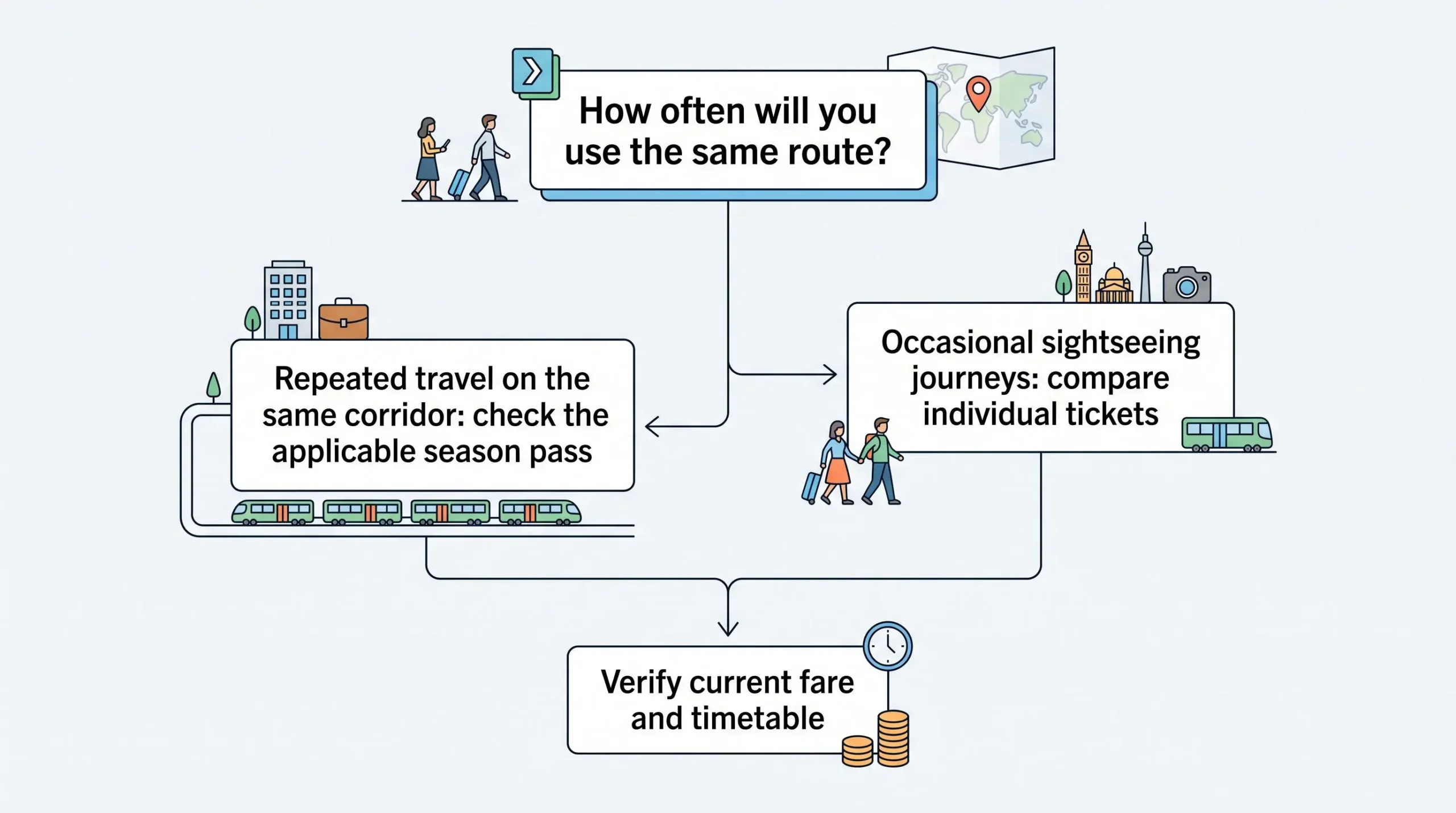
The useful comparison is based on trip frequency and route repetition, not on a universal rule that one product is always cheaper. Someone making a small number of sightseeing journeys has a different travel pattern from a commuter repeatedly using the same origin-destination corridor.
Autolinee Toscane also publishes a separate fast-route monthly pass category that includes the Siena-Florence corridor. Its validity remains tied to the origin-destination route stated on the pass, so its existence should not be interpreted as automatic coverage of San Gimignano.
- Occasional sightseeing journeys:
Compare the individual tickets required for the exact route segments in the itinerary.
- Repeated travel on the same corridor:
Check whether the applicable route-specific season pass matches the origin and destination that will be used repeatedly.
- Using a faster Florence-Siena service:
Check the relevant fast-route product separately rather than assuming it extends to San Gimignano.
For a broader itinerary, it can also help to compare European transport options before committing to one mode for every stage. The purpose is not to replace the Tuscany bus information, but to decide whether every leg of the trip needs to be handled in the same way.
What to check before you travel
Routes, fares and operating patterns are time-sensitive. The most reliable approach is therefore to verify the planned journeys shortly before travel rather than treating a previously published schedule as permanent.
- Confirm the exact route
Identify the actual origin and destination for each journey and whether the relevant service is line 131, 131R, line 130 or another current service.
- Check the timetable for the travel date
Verify the departure and stopping pattern rather than assuming that every service follows an identical schedule or provides a guaranteed connection.
- Verify the fare product
Compare the individual ticket requirements with any route-specific season pass that applies to the same origin-destination pair.
Because current transport information can change, the final purchasing decision should be based on the operator’s live information. Guidance on identifying and using reliable travel sources can also help separate official route information from outdated or incomplete travel advice.
For a Florence-Siena-San Gimignano itinerary, the practical conclusion is therefore not to assume that one regional pass covers every segment. Occasional travelers can compare the individual origin-destination tickets they actually need, while repeated use of the same corridor may justify checking the corresponding season pass. In either case, the route and fare should be verified for the intended travel date before purchase.